
Dhurrumtollah Academy
Backdrop
At the time when Anglican education was being introduced in Bengali society in late eighteenth century, many belonging to the Hindu community had compromised their religious beliefs and practices. On the other hand, quite a few erudite Englishmen and Europeans, who took to teaching in Bengal, lacked adherence to their religious orders. David Hare was an atheist, a fact that he never denied. Derozio with his ideology of Liberté, Égalité, Fraternité, the motto of the French Revolution, was devoted to the virtue of ‘reason’ in place of God. The new wave of literary thoughts shook the faith of native youth. The high tide of new acquisition of knowledge abandoned the age-old God of Hindus. No wonder, Vidyasagar became an atheist too.Bhattacharya David Drummond, one of the early Calcutta schoolmasters, branded heretic, incited the budding generation with uninhibited independent thinking at Dhurrumtollah Academy (DA) established three years before David Hare founded ‘Arpuli Pathsala’ in 1818.
Early English Schooling
E.W. Madge recalled the early days of education in Calcutta, when ‘few, if any, public schools existed’. It started with charity schools but from 1780s went for fee-paying Independent Schools often with a selective intake. The office of the schoolmaster was held by men from all walks of life. We find among them broken-down soldiers, bankrupt merchants or ruined spendthrifts betaking themselves to the profession of teaching—an occupation they tolerated only so long as it was a source of income. No wonder, therefore, that one finds an unsuccessful indigo planter, an old military pensioner, or even a destitute widow possessed of but scant education—all setting up in business as teachers, and succeeding too! As the teachers were lamentably wanting in education the standard of the knowledge imparted was correspondingly low. A plain English education—no higher than that comprised in the three R’s, reading-writing-arithmetic, was given. This was then considered sufficient for employment in the subordinate offices under the Government as well as in mercantile firms. It is interesting to note, however, that the principles of navigation and bookkeeping used to be specially studied. This was due to the fact that ships were being built here at the time, and persons possessing even a superficial knowledge of the theory of navigation soon found employment.Mudge
In consequence of the increased demand for education, many enterprising individuals began to feel that schools would make capital speculations. Mr. Archer was the first to establish a school for boys before the year 1800. His great success attracted others to the same field; and two institutions speedily took the lead – Mr. Farrell’s Seminary, and the Dhurrumtollah Academy conducted by Mr. Drummond. William Meadows Farrell (1770-1823) was one of the popular teachers of those early days. About 1801-2, he started a school with a Mr. Lathrop in Dhurrumtollah, but afterwards moved to Park Street. Like Drummond, Farrell was dearly loved by the schoolboys. Deb There was also a school conducted by Mr. Halifax, another by Mr. Lindstedt and a third by Mr. Draper. Annual examinations were first held by Mr. Drummond. The first examination of this kind gave the death-blow to the rival seminary of Mr. Farrell’s.
The first English school, the Charity School, was established in 1726. The Charity School and its offshoot the Free School were established to educate the city’s European orphans and children of poor Anglo-Indians. The education given by the School is of a ‘plain practical character and the boys generally become signalers in the Telegraph department, assistant apothecaries, writers in Government offices and mercantile houses, overseers of plantations, or obtain employment on Railways or in printing establishments, printing being an art successfully taught in the School’ Ajantrik. The Charity School apart, around twenty more grew up in the 18th-century Calcutta. Here is an open-ended list of 34 old schools of Calcutta so far identified:
| Charity School | c | 1726 | ||
| Free School | c | 1732 | ||
| Kiernander’s Mission School | c | 1758 17581178517851758 | Also known as Penney’s school | |
| Archer’s School | c | 1780 | ||
| Aldwell’s School | c | 1785 | ||
| Ward’s School | c | 1785 | ||
| Williams’ School | c | 1785 | ||
| Duncan’s School | c | 1786 | ||
| Miss Pippard’s School | c | 1788 | ||
| Mrs Stone’s School | c | 1788 | ||
| St Thomas School | 1789 | |||
| Mrs Copeland’s School | c | 1789 | ||
| Mrs Darley’s School | c | 1790 | ||
| Hope’s School | c | 1790 | ||
| Union School, Bhawanipur | 1793 | Students: Harris Chandra Mukherjee | ||
| Cunningham’s Calcutta Academy | c | 1795 | Students: Radha Kant Deb |
| Mrs Beck’s School | c | 1800 | ||
| Martin Bowl’s School | c | 1800 | Students: Mutty Lall Seal | |
| Farrell’s Seminary | c | 1801 | Founder: William Meadow Farrell & Mr Lathrop | |
| Thornhill’s Academy | 1802 | Founder: Thornhill | ||
| Sherbourne’s School | c | 1805 | Students: Prasannakumar Tagore, Dwarkanath | |
| Benevolent Institution | c | 1809 | Founder: Serampore Missionaries | |
| Hutteman’s School, Boitakhanah | c | 1812 | Founder: G S. Hutteman, Mem. Mission Church | |
| DhurrumtoIIah Academy | 1815 | Founder: Messrs Wallace and Measures | ||
| Hindoo School | 1817 | David Hare and other educationists | ||
| Arpuli Pathsala | 1818 | >Colootala Branch School > Hare School in 1867 | ||
| Anglo-Hindoo School | 1822 | Founder: Rammohun Ray | ||
| Parental Academy | 1823 | |||
| Calcutta Grammar School | 1823 | |||
| H T Travers’ Academy | c | 1823 | Founder: H T Traverse, Esq | |
| Oriental Seminary | 1823 | Founder: Gour Byasak. Student: Rabindranath | ||
| Verulum Academy | 1823 | conducted by Mr. Masters. DA merged with it | ||
| Alexander Duff School | 1830 | Founder: Alexander Duff | ||
| Christian Boarding School | 1832 | > United Missioary Girls High School | ||
| La Martiniere School | 1836 | Founder: General Martiniere | ||
| Hindu Free School | 1836 | Founder: Gobindacandra Byasak | ||
| Free College | 1842 | Mutty Lall Seal’s English school | ||
| Halifax’s School | ? | |||
| Lindstedt’s School | ? | |||
| Draper’s School | ? |
While the Charity School and the Free School were the earliest schools established for educating the European and Anglo-Indian children exclusively it was the Mission School, founded by Rev. Kiernander at Murgihatta quarter opened the doors of European education to the youth of India on the 1st of December 1758. Sunday Statesman
We know for certain from biographical sources that quite a few English schools, like Union School (1793), Cunningham’s Calcutta Academy (1795), Martin Bowl’s School (1800), Sherbourne’s School (1805), and Benevolent Institution (1809), all established before Dhurrumtollah Academy (1815), accommodated native Bengali boys who in their later life turned out to be Bengal luminaries like the eminent journalist Harrish Mukherjee, Raja Radhakanta Deb, philanthropist Mutty Lall Seal, Indian Lawyer Prasanna Kumar Tagore, Ramanath Tagore CSI, Prince Dwarkanath Tagore, and others. As it appears from their study materials described below, little was contributed by whatever they learnt in those schools to their life achievements.
The most striking of these liberal English schools, was the school of Mr. Sherbourne, a Eurasian, son of a Brahmin mother, where children of distinguished Bengali families, such as the Pathuriaghata Tagore family and Jorasanko Tagore family, received the rudiments of English education before passing to the Hindoo College.
Early School Curricula
It may be interesting to know, the books students had read at Sherbourne’s school were Enfield’s Spelling, English Reader, Royal English Grammar, The Universal Letter-Writer and Tooteenamah, or Tides of the Parrot (Mudge confused the title with Totakahini (1923) a book of Rabindranath Tagore.Mitra The prescribed books helped the students in developing their language skills which was surely considered critically important for improving verbal communication between the British and the native Bengalis in office situations and marketplaces. They said that the Serampore missionaries, in giving certificates to men, stated how many English words they knew. It was the custom in the schools to make the pupils learn by heart a certain number of words every day. Chroniclers however express serious doubts about the benefit of learning the English stock words alone in communicating with the Englishmen in working life.Shastri
The curriculum was more or less the same in English schools set up to prepare young people employable. We are already told that “A plain English education—no higher than that comprised in the three R’s was given” Mudge. Mr. Drummond did a great deal to raise the standard of education to a higher level. No other schools had shown any interest to go beyond numeracy and literacy to teach mathematic and verbal reasoning skills except schoolmaster Drummond who introduced in DA many branches of arts and sciences he thought necessary to making every boy a knowledgeable man.
Sooner the British Government lifted ban against missionary activities, the Serampore Missionary lead by William Carey initiated in 1813 the first collective movement for uplifting native education. However, it was not before five year more they could bring about major changes in collaboration with David Hare and his School Book Society and School Society besides their own Baptist Mission Press.
In 1817, the Serampore missionaries observed in a reviewing session that “The books which shall form the means of conveying knowledge to a nation at present immersed in worse than Egyptian darkness, become an object of serious consideration” Gupta. Even in Britain, where Christianity is professed by all, no one thinks of confining children at school wholly to the scriptures. The curriculum proposed in their first report(1817) on native schools was based on the following five basic topical textbooks:
l. A simple and concise Introduction to Arithmetic
2. A concise and well-written System of Geography
3. A Chronological Epitome of General History
4. A selection from their Own Books
5. Selection of the Scripture Ethics
For the English Departments, the School Book Society published the following four titles:
1. Mürray’s Spelling-book, Calcutta edition.
2. D’Anselme’s Spelling book, for the use of Bengalees
3. D’Anselmo’s Exercises on the English irregular verbs
4. Joyce’s Dialogues on Mechanics and Astronomy
Gupta
Yet, all these improvement in curriculum proved inadequate for the requirements of a national education system, and no way better than what Drummond introduced in DA 1n 1815.
Interracial School Environment
Thomas Edwards, Derozio’s first biographer, mentions that not only its educational environment was above religious intolerance but It was one of the peculiarities of Drummond’s school that … ‘European, Eurasian and native lads took the same lessons, and mingled together in the same school sports’.
Besides DA there was another famous school in Boitakhanah, presided over by a most estimable and orthodox pedagogue, a distinguished member of the Old Mission Church, Mr. Samuel George Hutteman (1769-1843). Those who cared less for orthodoxy and more for a thorough education, sent their sons to Drummond of Dhurrumtollah. Hutteman was a good classic, and turned out some fine scholars, but if thought and the power of thinking, and not grammatical niceties are the true aim of education, then the countryman of Hume, Drummond, was the better educator. Edwards The missionary and other privately run schools enlisted above had little or no commonalities in teaching methods and curricula between them and Drummond’s Academy. Drummond reshaped his school into a virtual nursery to bring up young boys, irrespective of race, cast and religion, into men of knowledge and integrity to serve humanity. The secular environment of DA immediately distinguished itself from all the existing English schools in Calcutta and was recognized as an excellent academic school and the kind of education it delivered was grossly missing until then in the city.
It is important to note, however, that there were some good missionary schools who welcomed students belonging to different races open-hearted. To give an instance we may refer to Statham’s Indian Recollections where he speaks of his visit at Benevolent Institution on its 1826 annual examination day. There were total 164 students in its boys’ section: 2 Europeans, 22 Indo-Britons, 102 Portuguese, 22 Hindoos, 7 Chinese, 3 Mussulmans, 2 Africans, 2 Armenians, and 2 Jews. To him, “it really was very interesting to witness such a multinational group of intelligent youths in the varied costumes of their different nations, yet all marshaled in the same classes, spelling the same words, and reading the same Scriptures. By the side of a Hindoo, whose white coppera [কাপড়/চাদর?] was gracefully thrown over his shoulders, so as to convey an idea of the classical costume of a Roman senator, stood a Chinese, with his hair plaited into a tail, which reached to his heels; and on the other side was a jet black’ woolly-headed Negro, in short jacket and trousers’; whilst on the right and left of these were Mussulmans, in white vests, with small muslin skull-caps bordered with tinseled glittering fringe,’ Armenians, Portuguese, and Indo-Britons of all hues, from the European roseate to the African sable” Statham. We may observe a semblance between DA and Benevolent Institution, both being humanitarian non-racist institutions. Benevolent Institution all the same was much less tolerant than Dhurrumtollah Academy which was free from any religious biasness or dogma and held the power of reasoning as the supreme object to achieve through education. Wenger
Dhurrumtollah Academy
The site of DA was surrounded by ‘Goomghur’ on the north, Hospital Lane on the west, Dhurrumtollah on the south, and Hart’s Livery Stables on the east, from each of which directions, gates entered the compound of the school Edwards. The hospital was specifically used for quarantine facilities in the 19th and 20th century.
William Carey reports that one Mr. Thornhill advertises (in 1802), “… encouraged by the liberal and increasing patronage of the public” to his academy, he had taken the house and garden in Dhurrumtollah Street lately occupied by H. T. Travers, Esq., which from its size and situation is particularly well suited for the purpose of an academy.” Carey believes this was the same building as that in which Mr. Drummond so long had his school, and the compound of which is now a bazaar. Carey
While it is still unclear exactly when DA was founded, we had a lead to know that it was a proprietary school of Messrs Wallace and Measures where in the year 1814 Mr. David Drummond secured a job of an assistant teacher on $150 a month (Edwards and others suggested it was Rs. 125), with board and lodging. Young Drummond arrived in India boarding ship Northumberland, which left Portsmouth in June, 1813. Madge After a voyage of five months, Drummond landed in India, which he had determined to make the land of his adoption. In DA he was required to teach Geography, Book-keeping and English Grammar.
Shortly after, following a minor tiff respecting the attendance of the scholars at the new Chowringhee Theatre, Mr. Wallace withdrew in April 1814. Drummond was made a joint proprietor with Mr. Measures. Mr. Measures begged leave to inform his friends and the public that the co-partnership between him and Mr. Wallace, was dissolved by mutual consent on the 1st Instant; and that the Dhurrumtollah Academy will in future be conducted by Measures and Drummond. Calcutta Gazette
for a little while, Mr. Measures finding himself unequal to the duty of managing a large school unaided. Soon Drummond became the sole proprietor of DA and its master who in his garden school grew young minds into champions of the Young Bengal, like a Henry Derozio or a Rajendra Dutta Shastri.
In 1831, nearly three decades after its inception, Derozio enthusiastically speaks about his school in public. To him, the most pleasing feature in Drummond’s School was its ‘freedom from illiberality’. At some schools in Calcutta objections often raised against native youth, not so much by the schoolteachers but by the schools’ Christian parents. Such things never happened in DA as there had been none of such illiberal feelings. It was quite delightful to witness the exertions of Hindoo and Christian youth striving together in the same classes for academical honours. “When the Hindoo and the Christian have learned from mutual intercourse how much there is to be admired in the human character, without reference to differences of opinion in religious matters, shall we not be brought nearer than we now are to that happy condition:
“When man to man the world o’er.
Shall brothers be and a’ that” [Robert Burns] Mukhopadhyay
Teaching at DA
Unlike the rest of the Calcutta schools about which we are going to discuss soon, DA not only pursued teaching on various branches of knowledge covering science, literature and metaphysics but also introduced new educational instruments to help the process of learning. DA introduced a Globe to its Geography class, a Brass Counter to Bookkeeping, and most amazingly, a mini-stage to aid Shakespearean studies. Besides those, Drummond introduced the system of Annual Examination to his school followed immediately by all other Calcutta schools.
The Annual Examination Day in DA was a big day of a school. Every year, the glorious personalities of literature, Philosophy & many wise men of educational & cultural field were earnestly invited as honorable guests to watch the annual examination of School. On that day, students got a golden chance to express themselves in front of those judicious personalities & they used to present their power of recitation, drama, reading etc on that theater. Brilliant Derozio participated in this occasion every year with a great interest, and the honorable guests became overwhelmed with his talent again & again! Semanti The Annual Examination was a mechanism to assess the progress of students’ performance and simultaneously the schools were also getting evaluated. The first examination of this kind gave the deathblow to Farrell’s Seminary, which was regarded the best school before Drummond took charge of Dhurrumtollah Academy and became its rival. Since then the Annual Examination Day was being celebrated in Calcutta schools as the their Annual Day. After nearly three decades on December 13th, 1831, only eleven days before his death, Derozio delivered his address nicely describing the Day of Examination at DA, which we believe remains unchanged so long the school existed:
The Examination of the Pupils of the Dhurrumtollah Academy, conducted by Messrs. Drummond and Wilson, took place on Saturday. Many ladies and gentlemen were present at this interesting examination, which appeared to give very general satisfaction Dr. Bryce, Dr. Tytler, Dr. Grant, Mr. D. L. Richardson, Mr. Adam, the Reverend A. Duff, Mr. Speed of the Hindoo College, Muha Rajah Kaleekrishun, Baboo Radha Prasad Roy and other distinguished gentlemen encouraged the youthful candidates by their presence. Dr. Tytler examined the Mathematical Geographical, and Astronomical classes, with the proficiency of which he was quite satisfied. The Book-keeping class was put to severe test by Mr. Speed ; but the boys were too knowing to be puzzled, and in a few minutes they satisfied him of their ability to journalize and post into the ledger any mercantile transaction. We believe that Mr. Drummond has the merit of having first introduced into the schools here the practice of teaching book-keeping by means of brass counters, which pass among the boy for goods and specie. Thus, the transactions which their books exhibit are bonafide real ones; and the interest which their purchases and sales excite among themselves is the principal cause of their retaining the instruction which is communicated to them. The Dhurrumtollah Academy maintains, in this respect, the character which it has always enjoyed. The French class acquitted itself with more ease and tact than any of the French classes in the other schools. The Examination terminated about 4 o’ dock. Edwards
Who Drummond Was
[In Plain English: “That time a man from Scotland, named David Drummond, founded a school at Dhurrumtollah in Calcutta. He was then a well-know person. Poems he composed attracted many minds. Poetry apart, he was thorough in literature and philosophy. We hear, because of differences of his religious opinions with his family members he had left his homeland for India for good. The freedom of thinking, which influenced the rise of the French Revolution, was burning bright in his mind all the time. When he opened the door of his English school in Calcutta the parents had spread words of apprehension that their boys might be turned into non-believers once they go there. In fear, many parents refrained from sending their children to Drummond’s school”]. Sastri
A Perfect Gentleman
Drummond, an extraordinary schoolmaster of nineteenth-century Calcutta, was a Scottish by birth, born in 1785. He became well known in Calcutta society as a polite Scottish gentleman with a weak physique but a gallant mind of a freethinker. Besides his strong grip on literary, scientific and metaphysical subjects, Drummond was regarded a man of high culture. He loved musicals and in his quarter ladies and gentlemen gathered to enjoy dramatic and musical recitals as well as profound analytic discussions on various themes. Ladies attending his parties found him brilliant. He was amiable and courteous but also a man of hasty temper of which Drummond himself was pretty aware and on every occasion he tried his best to restrain his emotion. It was unfortunate that he had to bear with the constraints lifelong. There were a few traits peculiar to his character. He was never known to slander anybody. If he had not a good word to say for a man, Henry Derozio reassured, he would not say an evil one. His personality apart, Drummond’s creative writings and philosophical transactions attracted enlightened minds around Calcutta. All the wise literature-lover Englishmen of that time knew him well and read his articles & poems with enthusiasm. Semanti
A Born Teacher
Above all, David Drummond was a born teacher, who followed in his own life whatever he taught, and imparted everything he valued in life to his students – the future game changers of the stagnated Indian traditional society. As mentioned already, becoming the Master of DA, Drummond took indiscriminately a batch of English, European, Eurasian and the native children under his wings. Among them was six-year-old Henry Louis Vivian Derozio. In eight years, Drummond made Derozio his ambassador to spread Drummond’s radical philosophy of freethinking and of living a modern uninhibited life, that ultimately contributed to the flowering of the Bengal Renaissance.Sarkar Derozio was universally acknowledged as the iconic preacher of freethinking. Yet, few knew it was Drummond who had taught Derozio to dare think freely, as Drummond himself practiced in every sphere of his activities – teaching writing or newspaper editing.
Idiosyncrasy & Ideology
David Drummond was born eleven years before the death of Robert Burns and was inspired by the lyrics of the ploughman poet, which filled all Scotland. A few of songs Drummond composed in the homely Doric of the native land, gained popularity.
Drummond believed that opinions should be formed on the basis of scientific knowledge and logical reasoning, and never to be influenced by authority, tradition, or dogma. Researchers like Thomas Edwards think there are good reasons to believe that the theological differences he had with his own family might have impelled young Drummond to leave his native land never to return.Edwards While in Scotland Drummond was immersed in the philosophy of the eighteenth-century Scottish Enlightenment, reading John Locke, David Hume, Thomas Reid, and Dugald Stewart. If not an open disciple of David Hume, Drummond was nonetheless a very doubtful person. It seems by nature, he was always unsure of anything, material or spiritual, till he reasons it out by himself. This dealing with uncertainties was surely a drawback for him in coming to terms with realities of life but to him it was also the key to success of a rational being. This philosophy, plain and simple for him, was to others grossly misunderstood and often mistaken for a heretic. He strongly believed in the theory of personal freedom of man, and was not ready to worship God neglecting the concern of mankind. “Only human being is the real God in this mortal life, and the only master! Thinking for mankind itself is the thinking for God!” His view of man as a conscious freethinker disagreed with the arguments of the phrenology – a fashionable philosophy in then Calcutta. Semanti
Drummond used to attend the meetings of the Phrenological Society founded in March 1825 with John Grant as Vice-president, and Patterson as Secretary. Most of the time he silently listened to the arguments in favour of phrenology. Then, to the amazement of the society, he delivered a series of discourse on Objections to Phrenology Drummond , establishing with five arguments that phrenology was not the true interpretation of nature, that its principles threw no sure light on the enquiry regarding the operations of the human mind. “This was the death-blow, not only to the Society, which never recovered from the vigor of Drummond’s attack, but to phrenology in India” Edwards.
In the year 1829, shortly after he published Objections to phrenologyhis health broke down due to mental stress and malnutrition, but still he could pursue his way of living with poetry, metaphysics and socialization and ,of course, teaching. “His residence was one of the most elegantly furnished in Calcutta”, and balls and suppers to kindred spirits were frequent. Nevertheless, Mr. Sandford Arnott, in presenting a copy of his own new Persian Grammar, wrote on the fly leaf—” To David Drummond, Esq., who amidst the luxuries of the East never lost his relish for the metaphysics and the muse of Scotland, which he cultivated so successfully” Edward.
Failing Health
To regain his increasingly failing health, Drummond sojourned at the Straits of Malacca, leaving the care of his flourishing school to a Mr. Wilson. On his return after a couple of years in 1830, he found DA had lost ground. It must be partly because of some inadequacies on the part of Mr. Wilson but largely it was the tactical move of the Calcutta clergymen to discredit DA as a school for non-Christian education. They did it indirectly through a newspaper advertisement for admission to a school on Circular Road, patronized by Thomas Dealtry, Archdeacon of Calcutta, which claimed to be “the only school in Calcutta where a Christian education could be obtained.” This chicanery apart, the fact that DA pursued a secular education system of which the parents were never too sure. It was not that Drummond was charged with open atheism; but the feeling amongst many parents was that, on the whole, there was some danger of the faith, implicit, unreasoned faith, of their fathers being unsettled by the fearless and independent thinking for themselves which characterized some of Drummond’s pupils. Edwards The public sentiment apart, the long absence from the scene of Drummond, the moving spirit behind the school, began to bring down his school’s public estimation irreversibly. Drummond, mentally tiered and physically exhausted, had to give up DA. With the proceeds of the sale of the school furniture and its goodwill he got admitted to the General Hospital and stayed there for years physically invalid but mentally fully alert.
End of Life
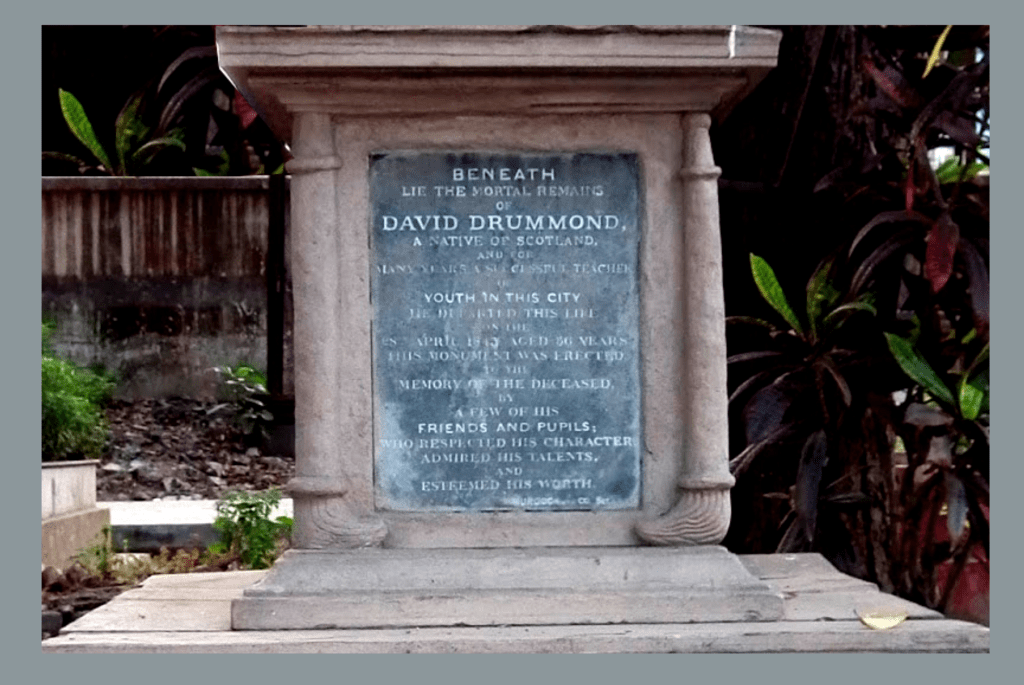
In the beginning of 1840, when his health improved a bit, yet not enough to take classes, Drummond decided to go for publishing a weekly paper, a desktop job that he could manage. He issued a prospectus for starting a paper entitled the Weekly Examiner– a journal of politics, news and literature. The public very generously supported him and more than five hundred subscribers were enlisted before the first issue of the weekly came out in March, 1840. Both Dr. John Grant and Dr. D. L. Richardson, his old friends, contributed regularly to his Weekly. In mid-1841, he was again down with spine disease and rendered him completely disabled to do editorial work what he tried between intervals of spasmodic gasps and agony. At last in April 1843, at the age of 56 he gave up and took leave for his journey to eternity after 30 years of stay in India, his adopted homeland. The day before his death a grateful pupil Mr. H. B. Gardener, removed him to his large house in European Asylum Lane at the corner of Gardener’s Lane, where he breathed his last. A monument erected by his friends and pupils over his grave in the new Burial Ground, Circular Road, bears respect to the old schoolmaster of Calcutta who had built the minds of his students, Derozio being one of them, and remotely the mind of the Derozians and the Young Bengal leaders instrumental to the happening of the Bengal Renaissance.
The Otherness of Drummond
Today, not many remember David Drummond. Those who do, barely knew him other than that he was the mentor of Derozio. Only a few know Drummond as ‘a poet of no mean order’. It is said, Drummond composed many Doric songs anonymously which became popular with the Scottish folks for a long while. Once Drummond dispatched a collection of his poems to get printed in England. But the ship, with her precious freight, was lost on the way without leaving a trace. When Sir Charles Metcalfe came to know about the fate of Drummond’s manuscripts, the poet’s frustration was not unnoticed. Metcalfe subscribed to fifty copies of Mr. Drummond’s poems that he intended to publish. His intention was, however, never fulfilled. Drummond’s acuteness in metaphysics was displayed in a very eminent degree in his Objections to Phrenology. He was a formidable metaphysician who wiped out the studies of phrenology from India. Drummond
Drummond’s reputation as an eminent schoolmaster was regarded by writers as high as any of the venerable schoolteachers of old Calcutta who taught the basic language skills to the British, Eurasian and Bengali boys some of whom became celebs in their later-life. It is, indeed, surprising that Drummond was placed with those in a class who had, unlike Drummond, drilled their pupils to securing an entry-level employment or getting admission to the Hindoo College. Drummond was different being a true educator whose mission was to rear young students to fine human beings, erudite freethinkers, empowered to bring about a new brave society replacing the hidebound decaying one that existed. While the others prepared their schoolboys eligible for studying at Hindoo College, Drummond sent his boy to teach there.
Drummond was the mentor of his boys and among them Henry Derozio was the most receptive of his thoughts and ideas. The disciples of Derozio, in their turn, emerged kindled with the same ideology as a band of uninhibited rational humanists to act as the agents of social and cultural change. Drummond’s intellectual ethical and aesthetic thoughts and ideas flowed down the long passages of time to influence flowering of the Bengal Renaissance. As we are reminded by the some insightful historians, “Rationalism in history is never a quest for absolute truth but a weapon for a new-found set of values, for a revolt against old ideals”. Sarkar In elaborating the theme, Tagore once quoted the immortal line of Burns — “a man’s a man for a’ that.” Sarkar. 1979 Strikingly, the same line from Burns Derozio had read in his 1831 Annual Day address at DA, as cited above.
Thomas reminds us that Drummond not only taught philosophy, secular and skeptical, he also gave them strong grounding in English literature, especially of the Renaissance, and assigned Shakespeare the central place in his training in reading, reciting, acting, and interpreting the classics of the English literary tradition. He was the first secular Shakespearean scholar before Richardson. He was the first who believed Shakespearean dramas are meant to be enacted on stage rather than read in a classroom. Dhurrumtollah Academy taught Shakespeare by performing acts by the students, and Derozio stood out to be the best among them.
Henry Derozio, Poet and the Activist
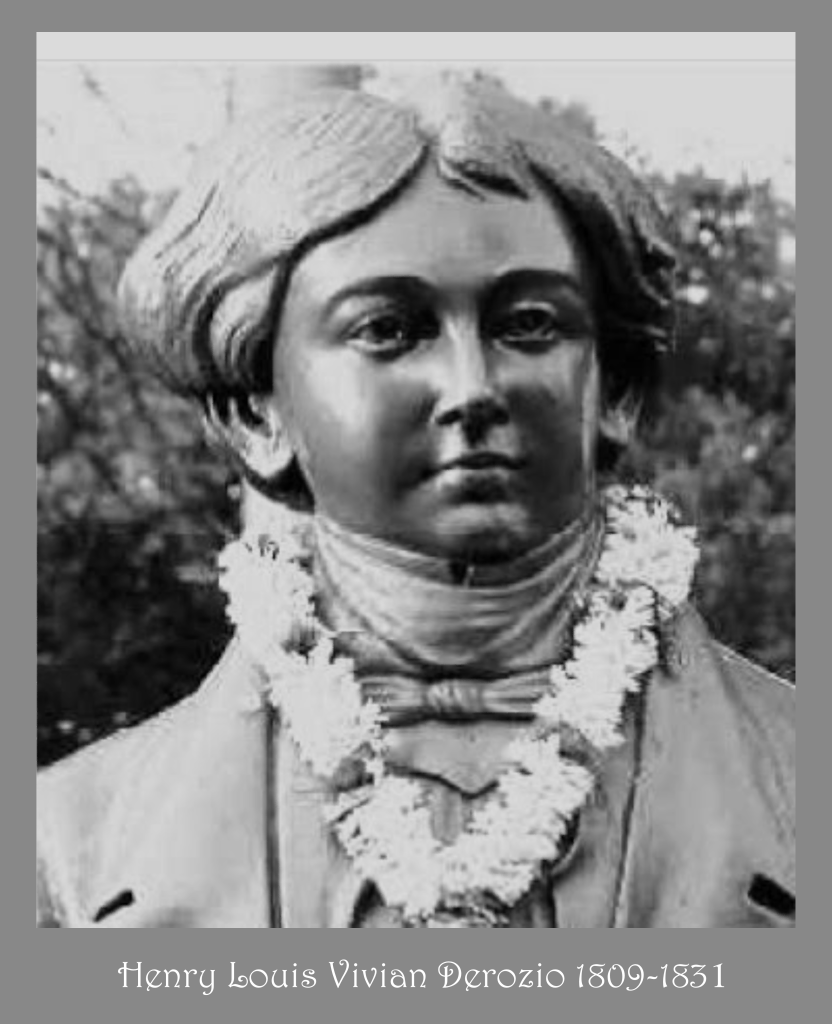
Backed by the deeply rooted radical humanist tradition that he inherited from his master David Drummond at DA, ‘Henry Derozio’s views about mankind were as liberal as those of Hare, Roy. and Tagore’. These liberal individuals were in no way amenable to whatever designs the Scottish Church or the imperial administration might have had.
Henry Louis Vivian Derozio entered DA at 6 in 1815 to receive liberal education under David Drummond. Drummond was equally versed and well-read in the classics, mathematics and metaphysics of his day. “Here Derozio received all the education that schools and schoolmasters ever imparted”. The young mind of Derozio was immediately impressed with his teacher’s cultural acumen and his power of independent thinking. Drummond through his teaching brought home the axiom ‘that opinions should be formed on the basis of science, logic and reason, and should not be influenced by authority, tradition, or any other dogma’. Drummond introduced the young boy to a whole range of western renaissance knowledge. During the period between 1815 and 1825, Drummond introduced Derozio to the works of Emmanuel Kant, David Hume, Francis Bacon and others and transformed his inquisitive pupil into an erudite scholar. Williams
Drummond seems to have had the power of imparting in an unusual degree, and on none of his pupils did he more distinctly impress his own individuality than on the young Derozio. Edwards Under the clear, incisive, logical guidance of David Drummond the impulsive and powerful mind of Derozio was quickened and spurred into action. For Derozio, the deep interest and understanding of literature and philosophy that he inherited from David Drummond was far more precious than his learning in recitation and acting at Drummond’s Academy. As the most promising student of Drummond’s Academy, having in him poetic talent, philosophic outlook, and literary taste in almost the same measure his master had, Derozio soon emerged as the morning star of the new learning of the West, later becoming one of the leading figures of the Bengal Renaissance. Edwards
Derozio’s Schooldays
Almost all the boyhood companions of Derozio became public figures in their later life. When they were grown up, W. Kirkpatrick, J. W. Ricketts, Robert J. Rose, Wale Byrne, Henry Andrews, R.H. Hollingberry, and some others, committed themselves to the social, spiritual and intellectual advancement of the East Indian people.
Kirkpatrick, M. Crowe, R. Fenwick and Other East Indians were the regular writers of the Old East Indian, a newspaper planned, edited and successfully carried on by Derozio till his death. Kirkpatrick also edited and wrote for the Orient Pearl, an annual published after the style of the Republic Of Letters, containing many articles of interest even for the new generation readers. Ricketts contributed to the Orient Pearl. Charles Pote was a Eurasian Artist whose portrait of Lord Metcalfe adorns the Town Hall of Calcutta, along with Derozio, David Hare, among other high-profile Calcuttans. Derozio being a member of the same cricket club spent the afternoons playing cricket with the same group of friends, DeSouza, DaCosta, Pote, W. Kirkpatrick, McLeod, Galloway and others, who took part in school theatricals for which Derozio wrote prologues before the age of 14. Edwards
Besides being a meritorious student Derozio also played winning roles in various extracurricular activities with an ease. Drummond established a little theater in the School, though he had no intention to built his pupils as professional actors, he just wanted to awake their power of thoughts as well as their hidden talents. Every year, the glorious personalities of literature, philosophy and many wise men of educational and cultural field were earnestly invited as honorable guests to watch the annual examination of School. On that day, students got a golden chance to express themselves in front of those judicious personalities & they used to present their power of recitation, drama, reading etc on that theater. Brilliant Derozio participated in this occasion every year with a great interest, & the honorable guests became overwhelmed with his talent again and again! On 25th December, 1817, the Calcutta Gazette wrote on his credit, “Henry Derozio – First in Recitation, Reading, Geography and general extraordinary acquirements at 8 years of age [won] a Gold Medal.”
On the very next year, 31st December of 1818, the Government Gazette wrote again on his brilliant result and award, “Henry Derozio-First Reader in the School, and remarkable powers in recitation, etc. (9 years of age)- Walkar’s Elocution.” Calcutta Journal of 1821 also says, “Henry Derozio and Hurry Doss Bose: the first for his pre-eminence among the rest of his school-fellows—”. The little boy became the pride of Dhurrumtollah Academy. Semanti We may recall here that Drummond had another brilliant student, Rajendra Dutta, whose guardian, Durgacharan, preferred to get him admitted to the school of David Drummond, a celebrated teacher of logical mind. Around the time Rajendra admitted Derozio passed out from DA.Ajantrik.2016
From the day one, when 6 year old Derozio entered the school till he left it a lad of fourteen, Drummond watched him keenly, and geared him to develop rapidly his splendid powers of intellect and imagination; and before he was twenty, six years after he left school, Derozio plunged into his eventful career of a game-changer. David Drummond, the grim, Scottish, hunch-backed schoolmaster, and Henry Derozio, the sprightly, clean-limbed, brilliant Eurasian boy, admired and loved each other as rarely master and pupil do. Edwards
The years Derozio spent at Drummond’s Academy were enough to school him in the classics and give him an understanding of Western traditions. Here at Drummond’s Academy, Derozio had developed his interest in Shakespeare, showing an exceptional ability to recite, act, and explicate scenes and characters from the plays, always making a mark as the best performer in examinations, functions, competitions, etc.
“It was Drummond who first taught schoolboys in Calcutta to recite Shakespeare. He encouraged his boys to display their histrionic abilities before guests at school functions.” It was also acknowledged that “From Drummond’s School, the practice spread to other institutions. There could hardly pass any ceremonial occasion at which something from Shakespeare would not be included; among the favourite passages was Portia’s homage to Mercy, Mark Antony’s oration at Caesar’s funeral, Shylock’s outburst against persecuting Christians, and Hamlet’s soliloquy on death. At these functions, the special prize awarded to the best reciter would invariably be a deluxe volume of the complete works of Shakespeare, bound in Morocco-leather.“ Lahiri
The End of DA
Since the early 1820s people began to be ‘painfully convinced that private schools did not answer the great purpose of national education’. A new system was required to take care of the changed views. The society perceived the necessity of attending to the moral and religious education of children.
The Parental Academy, through the influence and exertions of Mr. John Ricketts, was established on the 1st March 1823, and in June of the same year, the Calcutta Grammar School was established. On the establishment of these schools Mr. Drummond’s Academy very sensibly started declining and eventually was merged in the Verulam Academy conducted by Mr. Master. Verulam Academy was closed down soon when M. Master moved to La Martiniere as its Headmaster. Carey
Drummond’s Dhurrumtollah Academy remained in public sentiment for long and no one appreciate that the site of the Academy got lost to the high demand for commercial enterprises, as it reveals in newspaper insertion:
Thespacious premises in Dhurrumtollah, recently occupied as the Sailors’ Home, and previously as Mr. Drummond’s School, are to be turned into a market. The site is no doubt well adapted for such an object; yet, considering the recollection attached to that spot, the proposed employment of it looks like a desecration. It was here, according to tradition, that the Rev. David Brown, the senior Chaplain, kept his School, and taught the two sons of Charles Grant,—Lord Glenelg and the late Sir Robert. Bengal
Derozio, the Firebrand Teacher
In 1822, Derozio finished school at 14 as an accomplished freethinking scholar of the first order. In March 1828, Derozio was appointed as the Master of English Literature and History in the second and third classes Of the Hindoo College. Thomas remarks, “This appointment, seemingly so insignificant, marks the early development of one of the most important movements in the intellectual history of the native-born subjects of this land. No teacher ever taught with greater zeal, with more enthusiasm, with more loving intercourse between master and pupil than the short term of Derozio’s connection with the Hindoo College. Edwards Above all, he gave an impetus to the moral and intellectual development of the advanced students of the Hindoo College which lasted all their lives. He roused in them the spirit of the Young Bengal – a spirit of free enquiry which leavened all their thoughts and imbued them with a conviction which made them fearless of consequences in the pursuit and realization of truth. It is worthy of remark that this spirit had been imbibed by Derozio himself from his teacher, David Drummond, who was considered a most remarkable man and an avowed disciple of David Hume. He taught them how to think and ” worship truth’s omnipotence.” Ghosh In Hindoo College, Derozio also laid the foundation for making Shakespeare studies. From his student life at Drummond’s Academy to his teaching career at Hindu College, he remained committed to all the three aspects, reciting or elocuting and staging of Shakespeare studies. His inspiring, secular, and searching teaching has remained even to date the ideal of all great Shakespeare teachers in India. Dahiya
Besides Tarachand Chakrabarti (1804-55), a pre-Derozian, there were four firebrand Young Bengal – Rasikkrishna Mallik (1810-58), Dakshinaranjan Mukherji (1812-87), Krishnamohan Banerji (1813-85) and Ramgopal Ghose (1815-68) who confronted the Hindu conformists. Among others were: Harachandra Ghose (1808-69), Sib Chandra Deb (1811-90), Ramtanu Lahiri (1813-98), Radhanath Sikdar (1813-70), and Pearychand Mitra (1814-83). The Derozians were vilified in their early life when passion ran high; while their individual merits were later admitted, it has become almost a tradition to belittle Young Bengal as a trend. Contemporaries were shocked mostly by the indulgence in the socially forbidden food and drink, in the “cutting their way through ham and beef and wading to liberalism through tumblers of beer.” But this was mainly the means of asserting the right of individual judgment in matters of established customs, not unusual at a critical point of development. Sarkar Rev. C. Cesary describes the food habits of the Calcutta Hindoos he witnessed during the last quarter of the nineteenth century. “Here I have to remark that the Hindoos eat also meat at times, especially games; and orthodox Hindoos buy or send for meats from Kalighat; but the Young Bengal or not orthodox Hindoos, buy from the markets and have them cooked by Mussalman cooks“. Cesary
Godless Freethinkers & The Bengal Renaissance
Derozio was the prime mover behind the upsurge of the firebrand students of Hindoo College. They acted upon the principles of rational thinking taught by their young master Derozio and loved to be called themselves the ‘Derozians’. The philosophical stand Derozio took as a radical freethinker was exactly what he gathered at DA from his mentor David Drummond, who may be justifiably called an ‘unmoved mover’ a term borrowed from Aristotelianism which means the first cause of all movement and does not itself move.
One of the greatest intellectuals of recent time, Annadashankar Ray, speaks of Derozio as one of the colossuses who heralded the Bengal Renaissance. He wondered how long the Bengal Renaissance would have been possibly deferred in absence of the Young Bengal. On the other hand, Derozio’s absence could make the capability of the Young Bengal limited. Derozio taught them that nothing should be accepted without proper scrutiny and judgment, and to determine truth one should follow the arguments, both in favour and against, as an absolute necessity. Irrational faith is not the way to have the hall-mark of truth. Ray
Tagore in appreciation of the secular humanistic rationalist approach writes with conviction:
নাস্তিক সেও পায় বিধাতার বর
ধার্মিকতার করে না আড়ম্বর।
শ্রদ্ধা করিয়া জ্বালে বুদ্ধির আলো
শাস্ত্র মানে না মানে মানুষের ভালো।।Tagore
These fascinating words from Tagore’s poem serve as the most telling tribute to Henry Derozio or, more aptly directed to his Guru, the original freethinking radical humanist, David Drummond of whom seemingly he was less aware. In fact, to remain behind the scenes was one of the rules Drummond followed throughout his eventful life. His power of uninhibited freethinking and its precious fruits he gave away to his gifted pupils, and thus it was Derozio and his followers had come into unindiminishable prominence in history as the champions of the Young Bengal movement leaving Drummond, their Master in his shell. Drummonds in some respect was likeminded with David Hare. Hare too admitted saying, “It has alway been a rule with me never to bring myself into public notice, but to fill a private station in life.” Hare
Historians acknowledged that “David Hare has left an imperishable memory being one non-Indian figure prominently as a comrade of Rammohun in the field of the new education” Sarkar, but hardly ever declared unambiguously that it was Hare who initially thought of the new line of education and took to his friend Rammohun for his indispensible moral and material support and moved the Chief
Justice, Sir Hyde East, to initiate discussions in 1816 which led to the foundation in 1817 of the celebrated Hindu College and formation of the School Book Society, and the School Society as well.
Hare also a rare brand of secular humanist educator who stood by the wrongly maligned Derozio and his followers. Derozio dedicated to Hare his poem, ‘Your hand is on the helm – guide on young men’. On 17th February, 1831, Dakshinaranjan Mukherjee and 564 other young native gentlemen honoured David Hare with a signed address for his beneficial role in Education. Mukhopadhyay In response to the appeal of their young heart, David Hare told the gathering of the Young Bengal admirers that “I have now the gratification to observe, that the tree of education has already taken root — the blossoms I see around me. . . To maintain and to continue the happy career already begun, is entirely left to your own exertions. Your country men expect It from you, for they took upon you as their reformers and instructors.” Hare On the 17th of February 1831, David Hare blessed Derozio who had hardly any time even to see how his countrymen responded to the Young Bengal before he suddenly succumbed to untimely death on 26 December 1831. “It will be unusual to link with Young Bengal a second name, that of David Hare who seems so different from Derozio in so many ways. Hare was indeed no professional instructor or intellectual, no man of letters or of academic learning. Common to both was the passionate conviction that for India nothing was more essential than “a dissemination of European learning and science among her people”. Both encouraged freedom of thinking and discussion and inspired a courage and personal integrity in their followers “to throw off the fetters of that antiquated bigotry which still clung to their countrymen”. And unlike other leaders around them, both were “godless” secularists with little faith in denominations or religious instruction, and yet staunch idealists.“ In other words, both the men had the commonness in their quality of thinking, which is in essence the spirit of the Renascent Mind. The same mind that worked in composing Tagore’s ধর্মমোহ (Dharmamoha) quoted above.
ENDNOTE
The credibility of the uninhibited radical freethinker Anglo-Indian boy, Henry Derozio as the inspiration of the Young Bengal has been unanimously admitted by the historians. In the history of Bengal Renaissance, the Hindoo College was marked as the epicenter from where the students of Derozio stirred with radical idealism that posed an intellectual challenge to the religious and social orthodoxy of the Hindu society, whereas the burning torch that sparked Henry Derozio was aflamed elsewhere in an almost forgotten boys’ school nurtured by an eccentric schoolmaster without whom the Bengal Renaissance might not have happened the way it happened.
REFERENCES
Ajantrik. (2014). Charity School. Puronokolkata.Com. https://puronokolkata.com/2014/09/20/charity-school-later-free-school-calcutta-estb-c1726-1731/
Ajantrik. (2016). Rajendra Dutta. Puronokolkata.Com. https://puronokolkata.com/2016/06/28/rajendra-dutt-1818-1889/
Bengal Catholic Herald. (1844, November). Report. Bengal Catholic Herald, November 30, 1844. https://books.google.com.au/books?id=YmKXiWDrh8QC&pg=PP5#v=onepage&q&f=false
Bhattacharya, N. (1952). স্মৃতিকথা. In পুরাতন প্রসঙ্গ by Gupta, Bipin (2nd ed.). Bidyabharati. https://archive.org/details/in.ernet.dli.2015.299309/page/n5/mode/1up?q=রাধা+
Burns, R. (2001). Man’s a man for a’ that. Scottish Poetry Library. https://www.scottishpoetrylibrary.org.uk/poem/mans-man-0/
Calcutta Gazette, T. (1814, April 21). Advertisement. The Gazette. https://www.britishnewspaperarchive.co.uk/search/results/1800-01-01/1849-12-31?basicsearch=wallace and measures&exactsearch=false&place=calcutta%2C west bengal%2C india&retrievecountrycounts=false&mostspecificlocation=calcutta%2C west bengal%2C india
Carey, W. H. (1907). The Good old days of Honorable John Company from 1800 to 1858; compiled from newspapers and other publications; vol.2. Cambray. https://archive.org/details/in.ernet.dli.2015.39169/page/n421
Cesary, R. C. (1881). Indian gods sages and cities. Catholic Orphan Press. https://archive.org/details/in.ernet.dli.2015.128152
Dahiya, H. (2011). Shakespeare studies in Colonial Bengal; the early phase: A Sheffield Hallam University thesis [Sheffield Hallam University]. https://shura.shu.ac.uk/19526/1/10694407.pdf
Deb, B. K. (1905). The Early history and growth of Calcutta. RC Ghose. https://archive.org/details/in.ernet.dli.2015.99666
Drummond, D. (2018). Objections to phrenology: being the substance of a series of papers communicated to the Calcutta Phrenological Society, with additional notes (Kindle). Amazon. https://www.amazon.in/Objections-phrenology-communicated-Phrenological-additional-ebook/dp/B07FD57SLQ
Edwards, T. (1884). Henry Derozio, the Eurasian poet, teacher, and journalist. Newman. https://archive.org/details/henryderozioeura00edwarich/page/n5/mode/2up
Ghosh, Manmathanath, E. (1911). The life of Grish Chunder Ghose, the founder and first editor of “The Hindoo patriot” and “The Bengalee.” Cambray. https://archive.org/details/cu31924097526119/page/n53/mode/2up?q=drummond]%0A%0A%0A%0A
Gupta, K. (2014). Calcutta School-Buuk Society and the production of knowledge. English Studies in Africa, 57(1). https://colab.ws/articles/10.1080%2F00138398.2014.916908
Hare, D. (2001). A Reply to Young Bengal. In Song of the storm petrel ed. by Mukhopadhyay, Abirlal & ors. Progressive. https://archive.org/stream/in.ernet.dli.2015.150222/2015.150222.Complete-Works-Of-Henry-Louis-Vivian-Derozio_djvu.txt
Lahiri, K. C. (1961). Shakespeare in the Calcutta University. In Calcutta essays on Shakespeare ed. by Amalendu Bose. C.U. https://archive.org/details/in.ernet.dli.2015.460338/page/n1/mode/2up
Lethbridge, R. (ed. . (1907). Ramtanu Lahiri: Brahmin and Reformer: A history of the Renaissance in Bengal. From the Bengali of Pundit Shivanath Shastri. https://archive.org/details/ramtanulahiribra00sastiala
Madge, E. W., and Dhar, K. . (1913). Old Calcutta: Its schoolmasters. Calcutta Review. https://archive.org/stream/in.ernet.dli.2015.20871/2015.20871.The-Calcutta-Review1913_djvu.txt
Mittra, K. C. (1839). Memoir of Dwarkanath Tagore. hacker, Spink. https://archive.org/details/in.ernet.dli.2015.49182/page/n7/mode/2up
Mittra, P. C. (1877). A Biographical sketch of David Hare. Newman. https://archive.org/details/dli.csl.6805
Mukhopadhyay, Abirlal, and others (eds. . (2001). Song of the Stormy Petrel: Complete works of Henry Louis Vivian Derozio. Progressive. https://archive.org/stream/in.ernet.dli.2015.150222/2015.150222.Complete-Works-Of-Henry-Louis-Vivian-Derozio_djvu.txt
Puckett, S. G. (2000). Cultures of corruption: British liberalism and its colonial manifestations. Oklahoma U. https://books.google.co.in/books?id=kHW3DAEACAAJ&newbks=0&hl=en&source=newbks_fb&redir_esc=y
Ray, A. (2001). প্রাক কথা. In Song of the Stormy Petrel ed. by Abirlal Mukhopadhyay & ors. Progressive. https://archive.org/stream/in.ernet.dli.2015.150222/2015.150222.Complete-Works-Of-Henry-Louis-Vivian-Derozio_djvu.txt
Sarkar, S. (1979). On the Bengal Renaissance. Papyrus. https://archive.org/details/dli.bengal.10689.12523/page/n107/mode/2up
Sarkar, S. [Amit S. pseud. ]. (1947). Notes on Bengal Renaissance. People’s pub. https://archive.org/details/notesonthebengal035527mbp/page/n6
Semanti. (2012). Mr. David Drummond and his teaching; his influence on little Derozio. Blazes on Eternally. 22 July 2012.
Shastri, S. (1909). রামতনু লাহিড়ি ও তৎকালীন বঙ্গসমাজ (2nd ed.). SK Lahiri. https://doi.org/10.1192/bjp.111.479.1009-a
Statham, J. (1832). Indian recollections. Bagster. https://dn790004.ca.archive.org/0/items/indianrecollecti00statrich/indianrecollecti00statrich.pdf
Sunday Statesman Magazine. (1955, December 11). The Old Mission Church. The Statesman. https://www.kiernander.com/thesundaystatesmanmagazine1955/
Tagore, R. (1926). ধর্মমোহ. Animikhrabindranath. https://animikha.wordpress.com/2015/12/01/ধর্মমোহ-dhormomoho-the-illusion-of-religion/
Wenger, E. S. (1908). The story of the Lall Bazar Baptist Church Calcutta : being the history of Carey’s church from 24th April 1800 to the present day. Edinburgh. https://archive.org/details/storylallbazarb00wenggoog
Williams, M. (2016). Henry Derozio and the making Indian literature in English. In Academia. https://www.academia.edu/98492297/Henry_Derozio_and_the_Making_Indian_Literature_in_English
Discover more from PURONOKOLKATA
Subscribe to get the latest posts sent to your email.


